


Tel: +86-750-3806863
Email: sales@jyh-battery.com
Email: sales@jyh-battery.com
12, Bangmin Road, Jianghai District,Jiangmen City, Guangdong Province, P.R.China 529000
Views: 0 Author: Site Editor Publish Time: 2026-08-04 Origin: Site


Batteries fail silently. In controlled lab conditions, capacity numbers look reassuring. But deploy that same cell in a freezing cold chain facility, a mountaintop security camera, or a remote GPS tracker in winter—and the performance gap between standard and low temperature batteries becomes very real, very fast.
This article examines the safety profiles of low temperature batteries across three demanding applications: cold chain logistics, outdoor security systems, and GPS tracking devices. For each use case, the focus is on the chemistry best suited to the environment and the safety considerations that engineers and procurement teams need to understand before specifying a power source.
Temperature-controlled supply chains run on precision. A single monitoring gap—caused by a dead battery in a temperature logger or a failed wireless sensor—can compromise an entire shipment. That is precisely the scenario a Cold Chain low temperature battery is designed to prevent.
Standard lithium-ion cells begin losing usable capacity below 0°C, and charging at sub-zero temperatures risks lithium plating—a process where metallic lithium deposits form on the anode, creating internal short-circuit hazards. This is not just a performance issue. It is a safety concern.
LiFePO4 (lithium iron phosphate) chemistry addresses many of these risks. JYH Technology's low temperature LiFePO4 cells are rated for charge and discharge at -20°C with capacity retention above 80%. Critically, no heating components are required—meaning the battery manages cold conditions through chemistry rather than added power draw or mechanical complexity.
For cold chain operators, the safety profile of a Cold Chain low temperature battery rests on three pillars:
Stable discharge at sub-zero temperatures without thermal runaway risk
Safe charging even in freezing conditions, without lithium plating
Long cycle life that survives the repetitive freeze-thaw cycles common in refrigerated transport
Outdoor security cameras and perimeter monitoring systems must operate continuously—often in remote locations—through temperature swings from -40°C at night to above 0°C during the day. Battery failure in these systems does not just mean downtime; it means unmonitored periods with real operational consequences.
This is where lithium titanate oxide (LTO) chemistry stands out. An Outdoor Security low temperature LTO battery can charge and discharge at temperatures as low as -40°C, retaining over 60% capacity at that extreme. At -20°C, capacity retention rises above 80%. These figures come from JYH Technology's LTO product specifications, validated through cycle life testing at -40°C.
Beyond temperature tolerance, LTO chemistry offers a 100% depth-of-discharge (DOD) cycle life exceeding 10,000 cycles. For outdoor security installations that rely on solar charging with deep daily cycles, this longevity is significant. An Outdoor Security low temperature LTO battery also eliminates the need for embedded heating elements, reducing system complexity and the risk of heater-related failures inside sealed enclosures.
From a safety standpoint, LTO's inherent electrochemical stability—LTO anodes do not form solid electrolyte interphase (SEI) layers the way graphite anodes do—means lower risk of gas generation and reduced sensitivity to overcharge or overdischarge events.
GPS tracking devices must be small, lightweight, and capable of operating outdoors where temperatures regularly drop below -20°C. Fleet trackers, asset monitoring tags, and field research units all depend on batteries that will not shut down mid-deployment.
A GPS trackers low temperature LiFePO4 battery offers an effective solution for this application. LiFePO4 chemistry combines a flat discharge curve—which helps maintain accurate state-of-charge readings—with thermal stability across a wide temperature range and strong resistance to thermal runaway, even under mechanical stress or short-circuit conditions.
JYH Technology's low temperature LiFePO4 range includes cells in the 26650 and 18650 form factors, with discharge performance tested at -20°C. A GPS trackers low temperature LiFePO4 battery is particularly well suited to applications where:
Operating temperatures regularly fall to -20°C or below
The device cannot be retrieved for frequent battery servicing
Size and weight constraints rule out heating-assisted battery systems
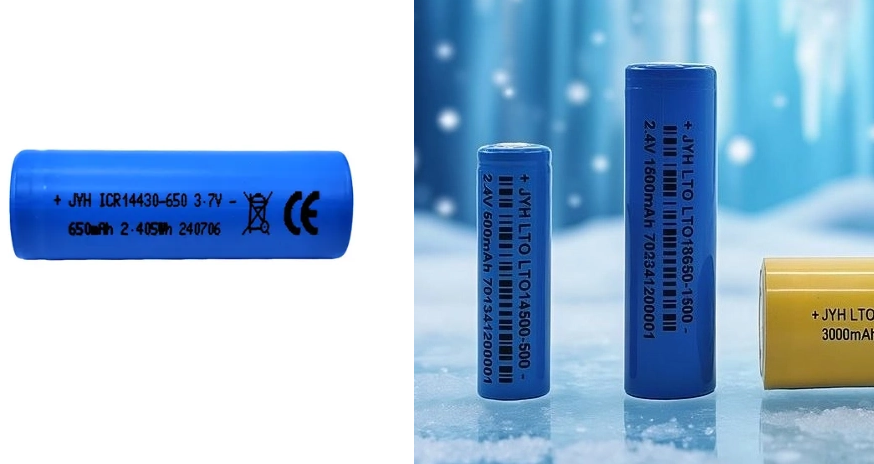
The table below summarizes key performance and safety parameters across the three primary use cases:
Application | Chemistry | Min. Charge Temp | Capacity at -20°C | Cycle Life | Heating Required |
|---|---|---|---|---|---|
Cold Chain Logistics | LiFePO4 | -20°C | >80% | 500–2,000+ cycles | No |
Outdoor Security | LTO | -40°C | >80% | >10,000 cycles | No |
GPS Trackers | LiFePO4 | -20°C | >80% | 500–2,000+ cycles | No |
LTO batteries outperform LiFePO4 in extreme cold and cycle life but come at a higher per-cell cost. LiFePO4 remains the preferred option for cost-sensitive applications where temperatures stay above -20°C. For environments that push below -30°C, LTO is the safer and more reliable choice.
Selecting the right low temperature battery chemistry is not a minor specification detail—it directly affects operational safety, system reliability, and total lifecycle performance. In cold chain logistics, outdoor security, and GPS tracking, the wrong battery can mean data loss, equipment failure, or unmonitored assets during critical windows.
JYH Technology, founded in 1999 and headquartered in Jiangmen, Guangdong, manufactures LiFePO4 and LTO cells specifically engineered for harsh-environment use. Their low temperature product lines are tested under IEC and UL standards, with cycle life validation conducted at sub-zero temperatures. For engineers and procurement teams specifying batteries for demanding field applications, the full product range is available at www.jyh-battery.com.
LTO (Lithium Titanate) chemistry supports safe charging at -40°C without requiring heating components. LiFePO4 chemistry supports safe charging down to -20°C without additional heating. Standard lithium-ion cells, by contrast, risk lithium plating when charged below 0°C—a condition that creates an internal short-circuit hazard over time.
LTO batteries are the safer and more reliable option below -30°C. LiFePO4 cells retain adequate capacity and safe charging behavior down to -20°C, but performance degrades significantly below that threshold. LTO cells maintain above 60% capacity at -40°C with no safety risk during charging at that temperature.
Yes. Both LTO and LiFePO4 low temperature batteries are designed for environments with repeated freeze-thaw cycles. LTO batteries are rated for over 10,000 cycles at 100% depth of discharge, with cycle life testing conducted at -40°C—making them suitable for outdoor applications subject to significant daily temperature variation.
LiFePO4 cells in standard 18650 and 26650 form factors are available in low temperature variants suited to GPS trackers. These cells do not require heating components, keeping device weight and complexity low. JYH Technology offers both form factors tested for stable performance at -20°C.
TL;DR: Low temperature batteries are safe and reliable in harsh environments when matched correctly to the application. Cold Chain low temperature battery solutions use LiFePO4 for stable sub-zero discharge and charging without heating components. Outdoor Security low temperature LTO battery systems leverage LTO's extreme cold tolerance—down to -40°C—and a 10,000+ cycle life. GPS trackers low temperature LiFePO4 battery units provide compact, thermally stable power for remote field deployments where servicing is infrequent. JYH Technology manufactures certified, tested cells across all three categories. Explore the full low temperature battery range at www.jyh-battery.com.


