


Tel: +86-750-3806863
Email: sales@jyh-battery.com
Email: sales@jyh-battery.com
12, Bangmin Road, Jianghai District,Jiangmen City, Guangdong Province, P.R.China 529000
Views: 0 Author: Site Editor Publish Time: 2026-09-17 Origin: Site


Standard lithium iron phosphate cells were never designed with Arctic winters or refrigerated warehouses in mind. Drop the temperature below freezing, and the internal chemistry slows down—ion movement through the electrolyte becomes sluggish, internal resistance climbs, and usable capacity can fall by 30% or more. For a solar installation in Scandinavia or a sensor network in the Canadian Arctic, that kind of performance drop isn't just inconvenient. It can mean total system failure at the exact moment reliable power matters most.
Battery manufacturers have responded by developing specialized cell chemistries and structural modifications that keep performance stable in extreme cold. But "cold-rated lithium battery" isn't a single category. It covers several distinct engineering approaches, each suited to a different operating environment. Understanding these differences helps engineers, procurement teams, and system designers choose the right cell rather than assuming any cold-weather label will do the job.
Inside a lithium battery, ions travel between the anode and cathode through a liquid electrolyte. This movement slows considerably as temperatures drop. Below freezing, standard electrolytes thicken, internal resistance rises sharply, and the risk of lithium plating during charging increases—a phenomenon that can permanently damage the cell and create safety hazards.
This is why most conventional lithium batteries carry charging restrictions near or below 0°C, and why capacity ratings quoted at room temperature rarely hold up once winter arrives. Manufacturers targeting cold environments address this problem at the material level, not just through external heating solutions.
A low temperature LiFePO4 battery is built around a modified electrolyte formulation designed to stay conductive well below freezing. Manufacturers also adjust separator porosity and electrode coating to reduce internal resistance at cold temperatures, which helps maintain usable capacity during both charge and discharge cycles.
Cells in this category typically maintain more than 80% of rated capacity when charging and discharging at -20°C, and some designs allow charging down to -40°C without triggering safety risks—eliminating the need for supplemental heating components. According to JYH Technology's product specifications, this class of cell also passes cycle life testing at -20°C, confirming that performance holds up over repeated use rather than just a single cold-start event. This makes it a practical fit for off-grid solar storage, outdoor sensors, and equipment left unattended through winter months.
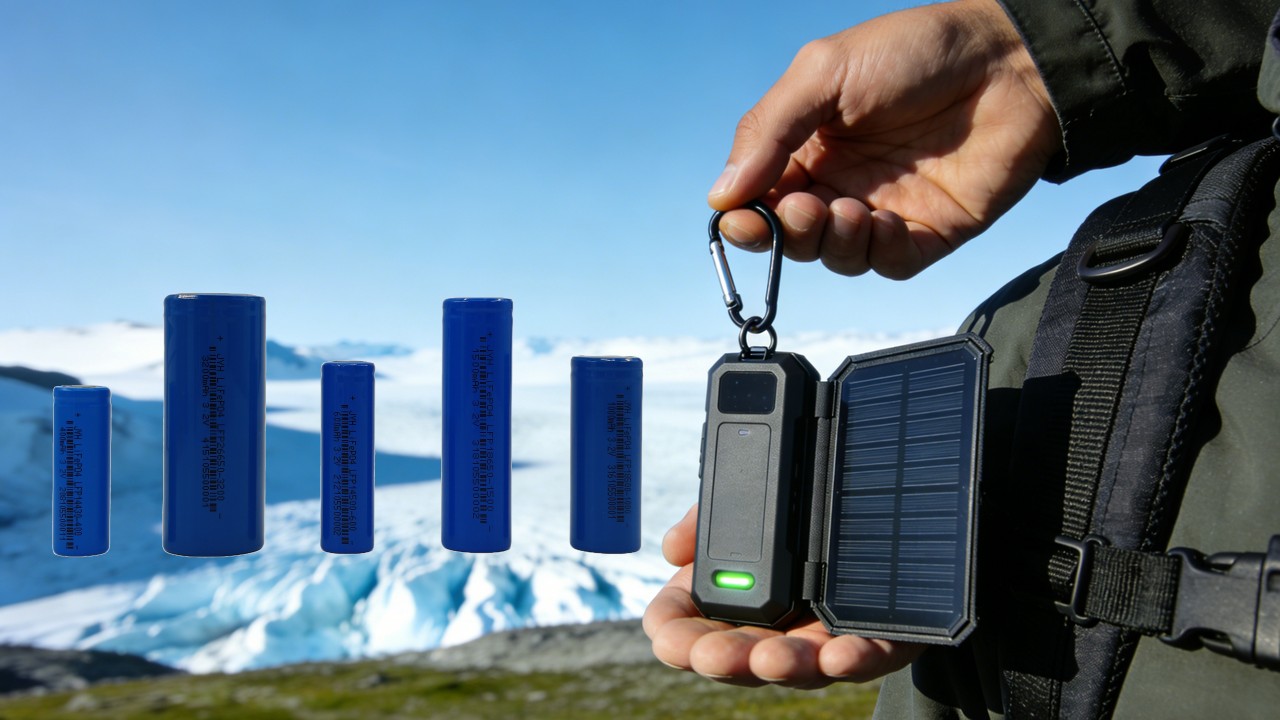
Not every cold-climate application needs steady, moderate power delivery. Some systems—emergency lighting, portable tools, and backup power equipment—need to release a large burst of current in a short window, even in freezing conditions.
A High Rate Discharge battery is engineered specifically for this scenario. Its internal structure prioritizes low internal resistance and high current-carrying capacity over sheer energy density, allowing it to deliver strong power output without excessive heat buildup or voltage sag. When paired with cold-tolerant materials, this cell type can support demanding, short-duration loads in environments where standard high-rate cells would underperform or degrade quickly. Applications like emergency lighting systems, which must remain functional the moment power is lost regardless of ambient temperature, rely on exactly this combination of rapid discharge capability and cold resilience.
Cold storage and refrigerated transport present a different challenge altogether: long-term reliability across thousands of charge cycles, often in equipment that can't be easily serviced. A Cold Chain Lithium Titanate battery is built to meet this demand.
Lithium titanate (LTO) chemistry replaces the graphite anode found in most lithium cells with lithium titanate, which offers exceptional structural stability and a much longer cycle life. According to JYH Technology's specifications, LTO cells can achieve more than 10,000 cycles at 100% depth of discharge, retain over 80% capacity at -20°C, and still deliver more than 60% capacity at -40°C—all without heating components. That combination of cycle longevity and deep-cold performance makes this cell type well suited to refrigerated trucking, cold storage monitoring equipment, and pharmaceutical logistics, where equipment replacement is costly and downtime isn't an option.
Feature | Steady Low-Temp Cell | High-Rate Discharge Cell | Cold Chain LTO Cell |
|---|---|---|---|
Primary strength | Stable capacity in sustained cold | Rapid power delivery | Long cycle life in deep cold |
Typical capacity at -20°C | >80% | Varies by design | >80% |
Typical capacity at -40°C | Charges safely, no heating needed | Not typically rated this low | >60% |
Cycle life focus | Standard to extended | Standard | 10,000+ cycles at 100% DOD |
Best-fit applications | Solar storage, outdoor sensors | Emergency lighting, portable tools | Cold chain logistics, refrigerated transport |
Heating components required | No | Depends on design | No |

The right choice depends on what the system actually needs from the battery, not just the ambient temperature it will face.
Choose a steady low-temperature cell if the application draws moderate, consistent current over time, such as remote monitoring equipment or solar-plus-storage systems in cold climates. Choose a high-rate discharge cell if the priority is delivering a strong burst of power on demand, particularly in safety-critical equipment like emergency lighting where a slow response isn't acceptable. Choose a cold chain lithium titanate cell if the equipment needs to survive years of daily cycling in sub-zero conditions with minimal maintenance, which is common in refrigerated logistics and pharmaceutical cold storage.
Cold-weather performance isn't a single feature you can bolt onto any lithium battery. It's the result of specific chemistry and structural choices made during cell design, and those choices vary depending on whether a system needs steady endurance, rapid power bursts, or years of daily cycling in freezing conditions. Matching the cell type to the actual operating demand—rather than defaulting to a generic "cold-rated" label—is what determines whether equipment keeps running when temperatures drop. Reviewing detailed specifications and cycle life data for each battery type remains the most reliable way to confirm a cell will perform as expected before it's deployed in the field.
Do cold-weather LiFePO4 batteries need external heating systems?
No. Cells engineered for low-temperature operation, including both the low temperature and cold chain titanate variants described above, are designed to charge and discharge in sub-zero conditions without supplemental heating components, which simplifies system design and reduces points of failure.
How much capacity is lost in extreme cold compared to room temperature?
It depends on the cell design. Standard lithium cells can lose 30% or more of their capacity below freezing, while specialized cold-rated cells are engineered to retain more than 80% capacity at -20°C, with some designs holding over 60% even at -40°C.
What are the main risks of using a standard lithium battery in cold climates?
Standard cells face increased internal resistance, reduced usable capacity, and a higher risk of lithium plating during charging in freezing conditions, which can permanently damage the cell and create safety concerns.
Are there alternatives to lithium iron phosphate for cold-weather applications?
Lithium titanate is the main alternative highlighted here, offering exceptional cycle life and cold-temperature stability, though it typically comes with lower energy density than LiFePO4 chemistry.
Who should consider a cold chain lithium titanate cell over a standard LiFePO4 option?
Operators running equipment that cycles daily for years in freezing environments, such as refrigerated transport or cold storage monitoring, benefit most from the extended cycle life this chemistry offers.


