

Views: 0 Author: Site Editor Publish Time: 2026-08-11 Origin: Site


Founded in 1999, JYH Technology Co., Ltd. has spent over two decades developing rechargeable battery solutions that perform where standard cells fail. Based in Jiangmen, Guangdong Province, China, JYH Technology specializes in LiFePO4, Lithium Titanate (LTO), NCM, and other advanced battery chemistries—each engineered to meet the specific demands of real-world applications.
Three application areas stand out for their reliance on cold-weather battery performance: outdoor security systems, solar tracking installations, and remote data logging. Each places unique stress on a cell. Cold temperatures reduce capacity, shorten cycle life, and in severe cases, create safety risks. JYH Technology addresses these challenges with purpose-built solutions, developed and tested in-house by a core R&D team with nearly 30 years of industry experience.
This article breaks down JYH's battery capabilities across these three use cases and explains the technical factors that make chemistry selection so critical in low-temperature environments.
Security cameras, motion sensors, and access control systems installed outdoors face a persistent challenge: they must operate continuously, regardless of season. In northern climates or high-altitude installations, ambient temperatures can drop well below -20°C—a range where many conventional lithium cells lose more than 30% of their rated capacity.
The Outdoor Security low temperature LTO battery from JYH Technology addresses this directly. Based on lithium titanate oxide (LTO) chemistry, it charges and discharges at temperatures as low as -40°C without requiring any external heating components. At -20°C, the cell retains more than 80% of its rated capacity. At -40°C, usable capacity remains above 60%—performance that LiFePO4 and NCM chemistries cannot match at that temperature extreme.
LTO cells also offer a 100% depth-of-discharge (DOD) cycle life exceeding 10,000 cycles, making them well-suited for applications that demand daily or continuous charge-discharge cycling. For security systems running 24/7 with solar backup, this combination of cold tolerance and long service life reduces maintenance frequency and lowers the total cost of ownership across the system's lifetime.
Solar tracker systems—motorized mounts that orient panels toward the sun throughout the day—are frequently deployed in open fields, deserts, and mountainous regions. These environments are exposed, often windy, and subject to wide temperature swings between night and day.
The Solar Tracker low temperature LTO battery serves precisely this environment. Because LTO chemistry avoids the lithium plating issues that cause capacity fade and safety risks during cold-temperature charging in other chemistries, JYH's LTO cells can accept a charge at -40°C with no safety risk and no heating element required. Cycle life testing at -40°C remains acceptable across the product range.
This matters for solar tracker deployments because available charging energy is lowest during winter, when temperatures are coldest. A battery that accepts a charge at sub-zero temperatures without heating overhead preserves more of the panel's limited output for productive use. For system designers evaluating cell options, JYH's LTO lineup offers a technically sound answer to the challenge of cold-weather energy storage in active tracker systems.
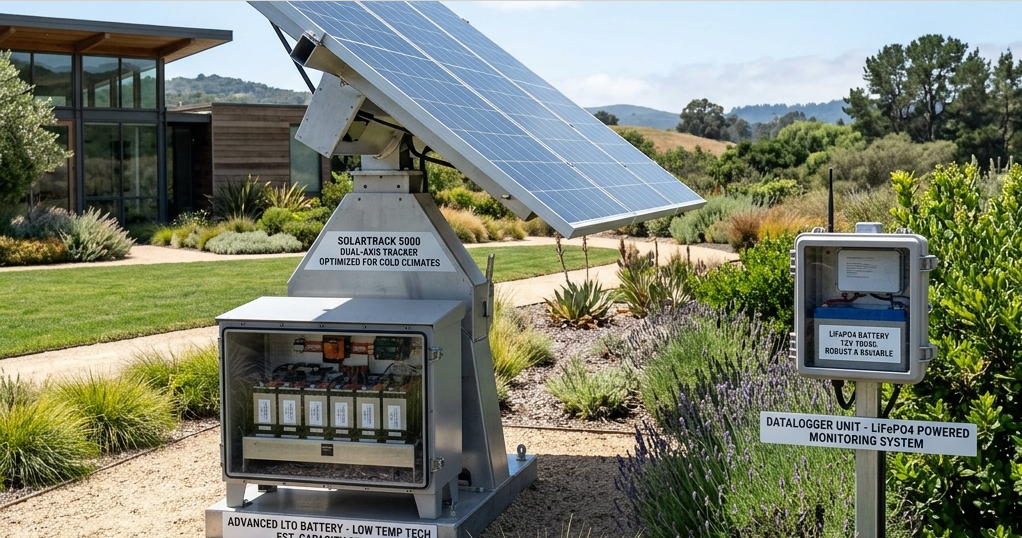
Remote data loggers—used in environmental monitoring, agricultural sensing, pipeline inspection, and industrial telemetry—have different requirements from security or solar applications. They typically consume very little current, operate for months or years between servicing, and are often deployed in locations where battery replacement is inconvenient or costly.
For these devices, the data logger LiFePO4 battery is the preferred choice. LiFePO4 chemistry offers excellent thermal stability, a flat discharge curve that simplifies voltage-based state-of-charge estimation, and a cycle life that extends well beyond 2,000 full cycles under standard conditions. JYH's low-temperature LiFePO4 cells are rated for charge and discharge at -20°C with capacity retention above 80%, and cycle life testing at -20°C meets acceptable thresholds for long-term field deployment.
Compared to LTO, LiFePO4 delivers higher energy density—an important factor in compact logger housings where space is limited. For applications that don't require charging below -20°C, LiFePO4 provides a better balance of runtime, longevity, and form factor.
Feature | LTO (Low Temperature) | LiFePO4 (Low Temperature) |
|---|---|---|
Minimum charge temperature | -40°C | -20°C |
Capacity retention at -20°C | >80% | >80% |
Capacity retention at -40°C | >60% | Not rated |
Cycle life (100% DOD) | >10,000 cycles | >2,000 cycles |
Heating components required | No | No |
Relative energy density | Lower | Higher |
Typical applications | Outdoor security, solar trackers | Data loggers, low-drain devices |
JYH Technology manufactures both chemistries in-house across facilities in Guangdong, Guizhou, Shandong, and Shanghai, with quality controls compliant with IEC62620 and UL924 standards. All cells undergo online inspection for capacity, voltage, impedance, and dimensions, as well as sampling inspection for safety performance including over-charge, over-discharge, short-circuit, and crush testing.
Can LTO cells charge at -40°C without a heating element?
Yes. JYH Technology's LTO cells are designed to charge at -40°C with no safety risk and no heating components required, making them suitable for outdoor applications in arctic or high-altitude environments.
Are JYH's low-temperature LiFePO4 cells certified to international standards?
JYH's LiFePO4 products comply with IEC62620, and select models are UL924 compliant. The company's quality management system is ISO9001 certified.
Is LTO or LiFePO4 better for a solar-powered remote sensor?
The choice depends on operating temperature range. LTO is the stronger option for environments below -20°C, particularly where the battery must accept a charge at very low temperatures. LiFePO4 suits applications where temperatures stay above -20°C and higher energy density is a priority.
Does JYH Technology offer custom battery pack assembly?
Yes. JYH Technology provides end-to-end battery assembly services tailored to specific industry needs, including custom cell configurations, connector types, and housing requirements.
JYH Technology Co., Ltd. has been producing rechargeable batteries since 1999. With over two decades of R&D experience and large-scale manufacturing capacity across four provinces, the company serves customers globally—from emergency lighting manufacturers to GPS and outdoor device OEMs.
For procurement teams and engineers evaluating batteries for cold-weather applications, JYH Technology's LTO and LiFePO4 product lines offer a technically credible, factory-direct option backed by formal quality certifications and comprehensive in-house testing capability. To review datasheets, request samples, or submit a product inquiry, visit www.jyh-battery.com or contact the sales team at sales@jyh-battery.com.
TL;DR: JYH Technology Co., Ltd., founded in 1999 and headquartered in Jiangmen, Guangdong, supplies purpose-built rechargeable battery solutions for cold-weather applications—including the Outdoor Security low temperature LTO battery rated to charge and discharge at -40°C with over 10,000 cycles, the Solar Tracker low temperature LTO battery designed for sub-zero charging without heating components, and the data logger LiFePO4 battery offering stable performance at -20°C with high energy density for compact, long-life deployments. All products are manufactured under ISO9001-certified quality controls and comply with IEC62620 standards


