

Views: 0 Author: Site Editor Publish Time: 2026-08-14 Origin: Site


Cold temperatures and batteries don't mix well. Most standard lithium-ion cells experience steep capacity drops when the mercury falls below freezing, making them unreliable for outdoor and industrial applications that must operate through winter months or inside refrigerated environments.
LiFePO4—lithium iron phosphate—chemistry handles cold significantly better. Its stable electrochemical structure resists the sluggishness that plagues standard cells at low temperatures. Cold weather LiFePO4 batteries from JYH Technology push this tolerance even further, delivering consistent performance well below the thresholds where other batteries give out.
One of the most compelling advantages is the ability to maintain meaningful capacity even at extreme temperatures. JYH Technology's cold Chain LiFePO4 battery charge and discharge at -20°C with capacity greater than 80%. Equipment stays operational in conditions that would leave a standard cell nearly useless.
For applications pushing down to -40°C, lithium titanate (LTO) chemistry fills the gap. LTO cells charge and discharge at -40°C with capacity greater than 60%, and cycle life testing at -40°C is acceptable—a specification that very few battery chemistries can match.
Many cold-weather battery systems rely on built-in heating elements to warm cells before use. These add complexity, weight, and additional failure points. JYH Technology's cold weather LiFePO4 batteries are rated to charge at -40°C with no safety risk and no heating components required. This simplifies device design and reduces maintenance burdens in remote deployments.
Cycle life is where cold weather LiFePO4 batteries clearly separate from the competition. Standard lithium-ion cells degraded repeatedly through freeze-thaw cycles lose capacity quickly. LiFePO4 chemistry is far more stable. JYH's LTO cells achieve 100% depth-of-discharge (DOD) cycle life greater than 10,000 cycles, and cycle life testing at -20°C remains acceptable—meaning repeated cold exposure doesn't accelerate degradation the way it does with other chemistries.
GPS trackers deployed in remote field locations—mounted on vehicles crossing arctic terrain, attached to livestock on high-altitude farmland, or embedded in environmental monitoring stations—require batteries that never fail in the cold. A tracker that stops reporting because its battery fell flat at -15°C is worse than no tracker at all.
This is precisely the scenario that makes a GPS trackers low temperature LTO battery a practical solution. LTO chemistry's extreme low-temperature tolerance suits trackers that need continuous operation through harsh winters without active heating. JYH Technology's LTO cells maintain over 60% capacity at -40°C and have passed cycle life testing at that same threshold, supporting long-term remote deployments without routine servicing.
Cold chain logistics—the movement and storage of temperature-sensitive goods like pharmaceuticals, fresh produce, and vaccines—depends on uninterrupted monitoring. Temperature sensors, data loggers, and wireless communication devices must function reliably inside refrigerated trucks, cold storage warehouses, and freezer facilities where ambient temperatures can range from 0°C down to -25°C or colder.
A Cold Chain LiFePO4 battery offers a strong combination of safety, longevity, and low-temperature performance for these environments. LiFePO4's inherent chemical stability means reduced risk of thermal runaway—critical when batteries are deployed alongside temperature-sensitive, high-value cargo.
For the coldest environments, such as blast freezers or pharmaceutical deep-freeze storage, a Cold Chain low temperature LiFePO4 battery provides the extended temperature range required. JYH Technology's low temperature LiFePO4 cells maintain greater than 80% capacity at -20°C and are rated to charge safely at -40°C without heating components, covering even the most demanding cold chain deployments.
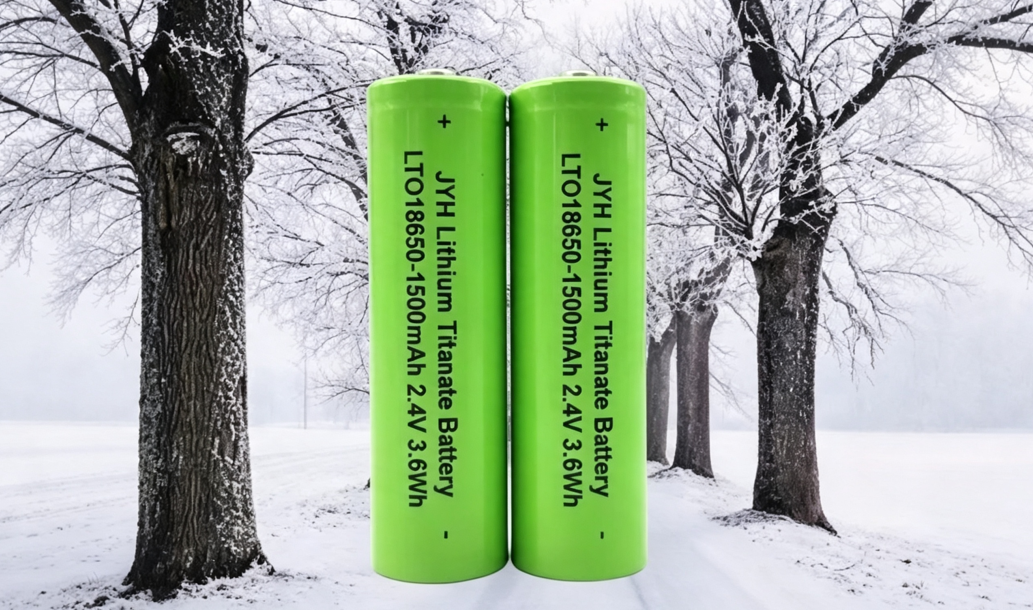
The table below summarizes how different battery chemistries perform in sub-zero conditions, based on JYH Technology's product specifications .
Battery Chemistry | Min. Discharge Temp. | Capacity at -20°C | Capacity at -40°C | Heating Required | Typical Cycle Life (100% DOD) |
|---|---|---|---|---|---|
Standard LiFePO4 | ~0°C | ~50–60% | Not recommended | Often yes | ~2,000 cycles |
Cold Weather LiFePO4 | -20°C | >80% | Limited | No | 2,000+ cycles |
Lithium Titanate (LTO) | -40°C | >80% | >60% | No | >10,000 cycles |
Standard Li-ion (NCM) | ~0°C | ~40–55% | Not recommended | Often yes | ~500–1,000 cycles |
The decision between cold weather LiFePO4 and LTO chemistry depends on the operating temperature range and cycle life demands of the specific application.
Cold weather LiFePO4 suits applications operating at -20°C or warmer. It offers a practical balance of cost efficiency, safety, and cold tolerance. It's the sensible choice for most cold chain monitoring devices, outdoor sensors, and asset trackers in temperate-to-arctic climates.
LTO chemistry becomes the stronger option when temperatures consistently fall below -20°C, or when cycle life above 5,000 cycles is a firm requirement. The higher cell cost is offset by extreme durability and the elimination of heating systems—both of which carry real savings over a product's operational lifetime.
Both chemistries share LiFePO4's core safety profile: no thermal runaway risk, stable cell voltage, and no cobalt in the cathode.
Can LiFePO4 batteries charge at temperatures below -20°C?
Standard LiFePO4 cells are generally not recommended for charging below 0°C. However, JYH Technology's cold weather LiFePO4 cells are specifically engineered to charge at temperatures as low as -40°C with no safety risk and without heating components.
Is LTO or LiFePO4 the better choice for cold chain monitoring equipment?
Cold chain LiFePO4 is sufficient for most refrigerated and cold storage applications (down to around -20°C), offering over 80% capacity retention. For blast freezer environments or deployments below -20°C, LTO chemistry is the better fit due to its ability to operate at -40°C with acceptable cycle life.
Do cold weather LiFePO4 batteries require special charging equipment?
No special chargers are required in most cases, though the charge protocol must be compatible with LiFePO4 voltage specifications. JYH Technology's cells are designed to remove the need for heating components, simplifying the overall system design.
Are cold weather LiFePO4 batteries suitable for GPS tracking in remote winter environments?
Yes. Cold weather LiFePO4 and LTO cells are both well-suited for GPS tracking in sub-zero conditions. LTO in particular supports cycle life testing at -40°C, making it a dependable option for trackers deployed in arctic or alpine environments without maintenance access.
Are there safety certifications available for JYH Technology's cold weather batteries?
JYH Technology is ISO9001 certified and conducts testing across electrical and safety standards including IEC and UL. Specific models such as the LFP26650-3400 comply with UL924. For certification details by product, visit www.jyh-battery.com.
Cold weather LiFePO4 batteries solve one of the most persistent reliability challenges in outdoor and industrial power systems. They retain usable capacity at -20°C, charge safely at -40°C without heating elements, and hold up through thousands of cycles in sub-zero conditions. For GPS tracking, cold chain monitoring, and other demanding cold-climate use cases, this chemistry represents a proven and dependable power source. JYH Technology, founded in 1999, manufactures a comprehensive range of low temperature LiFePO4 and LTO battery solutions from its facilities in Guangdong Province, China. For technical specifications, custom battery pack options, or application guidance, visit www.jyh-battery.com or contact the team directly at sales@jyh-battery.com.
TL;DR: Cold weather LiFePO4 batteries maintain over 80% capacity at -20°C and charge safely at -40°C without heating components. LTO chemistry extends this range to -40°C with a cycle life exceeding 10,000 cycles. Both chemistries are proven solutions for GPS tracking, cold chain monitoring, and other sub-zero industrial applications where standard batteries fall short


