

Views: 0 Author: Site Editor Publish Time: 2026-09-07 Origin: Site


Cold weather does reduce the usable capacity and charge efficiency of LiFePO4 batteries temporarily, but it does not permanently shorten their lifespan under most conditions. Specialized low-temperature LiFePO4 cells can charge and discharge at -20°C while retaining over 80% capacity, making them viable for demanding cold-climate applications.
A battery rated for thousands of cycles doesn't always deliver on that promise when temperatures drop. Cold weather changes the internal chemistry of lithium iron phosphate cells in ways that affect both short-term output and long-term durability—but the picture is more nuanced than a simple "cold kills batteries" conclusion.
For engineers, procurement teams, and system designers working in cold climates, understanding exactly where the risks lie—and where specialized cell chemistry can close the gap—is essential for selecting the right power solution.
LiFePO4 (lithium iron phosphate) batteries are widely valued for their thermal stability, long cycle life, and safety profile. Standard LiFePO4 cells typically operate between -20°C and 60°C during discharge, though charging at sub-zero temperatures is where the real risk lies.
At low temperatures, lithium-ion mobility slows significantly. The electrolyte becomes more viscous, internal resistance rises, and the rate at which lithium ions intercalate into the graphite anode decreases. The practical result: capacity drops, voltage sags under load, and charging efficiency falls.
Charging a standard LiFePO4 cell below 0°C at normal rates can cause lithium plating on the anode—a condition where metallic lithium deposits form instead of properly intercalating. This is irreversible. Each charge cycle under these conditions degrades the cell's structure, permanently reducing capacity and accelerating end-of-life.
This is the key distinction: cold weather itself doesn't shorten lifespan. Charging in cold weather without proper design precautions does.
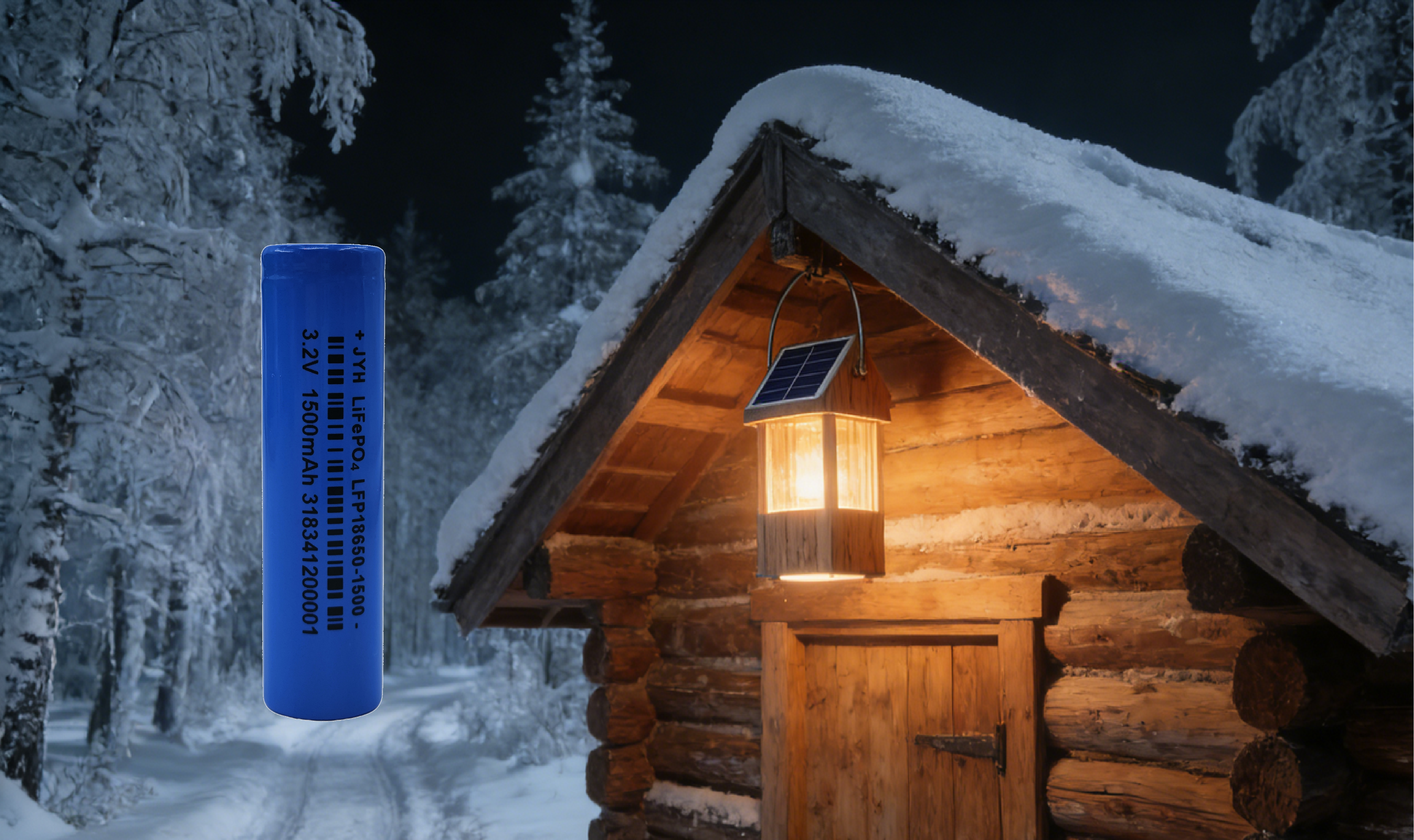
The table below summarizes how standard and low-temperature LiFePO4 cells compare across key cold-weather performance metrics:
Parameter | Standard LiFePO4 | Low-Temperature LiFePO4 |
|---|---|---|
Discharge temp range | -20°C to 60°C | -40°C to 60°C |
Charge temp range | 0°C to 45°C | -20°C to 45°C (no heating required) |
Capacity at -20°C | ~50–70% of rated | >80% of rated |
Capacity at -40°C | Very limited / fails | >60% of rated |
Cycle life at -20°C | Degraded significantly | Acceptable per cycle life testing |
Heating component required | Often yes | No |
Risk of lithium plating | High below 0°C | Mitigated by cell design |
Low-temperature LiFePO4 cells achieve this performance through electrolyte formulation changes, optimized electrode materials, and design choices that reduce internal resistance at sub-zero conditions. JYH Technology's low-temperature LiFePO4 series, for example, supports charging and discharging at -20°C with capacity retention above 80%, and certain models extend safe charging to -40°C without requiring any heating components.
Refrigerated logistics and pharmaceutical transport are among the most demanding use cases for batteries in cold environments. A Cold Chain LiFePO4 battery must deliver consistent power across wide temperature swings—from a loading dock at ambient temperature to a refrigerated trailer running at -18°C or colder.
Standard cells often fail this test not by dying outright, but by delivering reduced runtime, triggering low-voltage cutoffs prematurely, or suffering cumulative degradation from repeated cold charging. Over months of operation, this translates to earlier replacement cycles and higher total operating costs.
A purpose-built low-temperature LiFePO4 cell eliminates the need for thermal management hardware in many cold chain deployments. Removing heating components reduces system complexity, weight, and potential failure points—an advantage in mobile and space-constrained applications like refrigerated vans, medical cold storage units, and portable monitoring devices.
Outdoor solar monitoring systems face a specific challenge: they must remain operational year-round, often in locations where nighttime temperatures fall well below freezing. The battery powering a solar monitoring system low temperature LTO battery represents one proven solution for the most extreme environments—lithium titanate (LTO) chemistry offers a 100% depth-of-discharge cycle life exceeding 10,000 cycles, with acceptable cycle life testing down to -40°C.
However, LTO cells carry higher costs and lower energy density compared to LiFePO4. For many solar monitoring deployments, a solar monitoring systems LiFePO4 battery—specifically a low-temperature variant—strikes a better balance between cold-weather capability, energy density, and total cost over the system's operational life.
The selection depends on the minimum operating temperature and whether the system charges during cold daylight hours. At sites where temperatures stay above -20°C, low-temperature LiFePO4 handles the workload without additional heating systems. At sites regularly reaching -40°C, LTO becomes the more reliable option despite its trade-offs.

Battery lifespan in cold climates depends less on the temperature itself and more on how the system is designed around it. Several practices consistently extend service life:
Restrict charging to safe temperature windows. A battery management system (BMS) configured to block charging below 0°C for standard cells—or below -20°C for low-temperature cells—prevents lithium plating and preserves long-term cycle life.
Use cells rated for the actual operating range. Deploying standard cells in environments that regularly drop below -10°C creates unnecessary stress. Matching the cell specification to the deployment environment is the most direct way to protect lifespan.
Avoid deep discharge in extreme cold. Discharging to very low state-of-charge levels at sub-zero temperatures increases stress on the electrodes. Where possible, maintain a minimum state of charge of 20% during cold exposure.
Verify cycle life data at operating temperature. Room-temperature cycle life figures don't reflect cold-climate performance. Manufacturers that publish cycle life test results at -20°C provide a more accurate basis for system lifetime planning.
LiFePO4 remains a strong choice for cold-weather applications when the right cell variant is selected. Standard LiFePO4 cells are suitable for environments that stay above 0°C during charging. Low-temperature LiFePO4 cells extend reliable operation to -20°C without heating systems. LTO cells are the appropriate choice for environments that consistently reach -40°C, where their superior low-temperature performance justifies the trade-off in energy density.
JYH Technology has developed specialized battery solutions across all three categories, with R&D focused on high-temperature, low-temperature, and long-cycle-life performance. Their low-temperature LiFePO4 product line is designed specifically for deployments where cold-weather reliability is non-negotiable.
Cold weather does not have to shorten the life of a LiFePO4 battery. With the right cell chemistry, a properly configured BMS, and operating practices matched to the deployment environment, these batteries can deliver full rated cycle life across years of cold-climate service.
Does cold weather permanently damage LiFePO4 batteries?
Cold temperatures alone do not cause permanent damage during discharge. Permanent damage—specifically lithium plating—occurs when standard LiFePO4 cells are charged below 0°C. Low-temperature LiFePO4 cells are engineered to avoid this risk, supporting safe charging down to -20°C or lower.
At what temperature does a LiFePO4 battery lose significant capacity?
Standard LiFePO4 cells begin showing notable capacity reduction below -10°C, with capacity dropping to 50–70% of rated value at -20°C. Low-temperature LiFePO4 cells retain more than 80% of rated capacity at -20°C and above 60% at -40°C.
Do low-temperature LiFePO4 batteries require heating pads or thermal management systems?
Purpose-built low-temperature LiFePO4 cells are designed to operate without heating components. This simplifies system design, reduces weight, and eliminates a potential failure point in mobile and remote deployments.
Which battery chemistry performs best below -30°C?
Lithium titanate (LTO) batteries are the most reliable option below -30°C. LTO cells support charging and discharging at -40°C, maintain more than 60% capacity at that temperature, and offer cycle life exceeding 10,000 cycles at 100% depth of discharge.
Can LiFePO4 batteries be used in solar monitoring systems in cold climates?
Yes. Low-temperature LiFePO4 cells are well-suited for solar monitoring systems low temperature LTO battery applications in environments above -20°C. For sites that regularly experience temperatures at or below -40°C, LTO cells offer greater reliability at the cost of lower energy density and higher unit cost.


