


CN:


Views: 0 Author: Site Editor Publish Time: 2026-07-06 Origin: Site


Temperature is one of the most damaging variables a battery faces. From Arctic monitoring stations to desert solar installations, the conditions a battery operates in directly determine how long it lasts—and how reliably it performs. For engineers, procurement teams, and system designers, understanding what extreme temperatures do to rechargeable batteries is essential before specifying any power solution.
This article covers how temperature affects rechargeable battery chemistry, what makes a wide temperature battery different, and what to look for in a rechargeable battery manufacturer capable of delivering cells that hold up under real-world thermal stress.
Standard rechargeable batteries—whether lithium-ion (Li-ion), LiFePO4, or nickel-based chemistries—rely on electrochemical reactions to store and release energy. These reactions are highly sensitive to temperature. Push a cell outside its rated range, and degradation accelerates.
At high temperatures, elevated heat speeds up the chemical reactions inside the cell. While this can temporarily boost output, it also accelerates electrolyte decomposition, increases internal resistance over time, and shortens cycle life. Sustained operation above 60°C causes irreversible capacity loss in most standard lithium cells.
At low temperatures, the opposite problem emerges. The liquid electrolyte thickens, ion mobility slows, and the battery struggles to deliver its rated capacity. Standard lithium cells can lose 30–50% of their usable capacity before reaching –20°C. Charging below freezing is particularly dangerous—lithium plating on the anode can cause internal short circuits and create safety risks.
The combined effect of repeated thermal cycling—expanding and contracting between hot and cold—also places mechanical stress on internal components, causing micro-cracks in electrode materials and weakening the structural integrity of the cell over time.
Temperature Range |
Effect on Standard Li-ion |
Effect on Wide Temperature Battery |
|---|---|---|
Above 60°C |
Accelerated degradation, electrolyte breakdown |
Stable charge/discharge; designed for up to 85°C |
0°C to 25°C |
Optimal performance range |
Full rated capacity |
–20°C |
Capacity drops 30–50% |
Capacity retention >80% |
–40°C |
Near-zero usable capacity; charging unsafe |
Discharge possible; capacity >60% (LTO chemistry) |
A wide temperature battery is specifically engineered to maintain reliable performance across a much broader thermal range than standard cells. The design differences are significant—from electrolyte formulations that remain fluid at sub-zero temperatures to electrode materials that resist degradation at sustained high heat.
Two chemistries are most commonly used in wide temperature applications:
LiFePO4 (Lithium Iron Phosphate) offers excellent thermal stability, long cycle life, and a flat discharge curve. High-temperature LiFePO4 cells can support charge and discharge at up to 85°C while complying with IEC 62620 standards. Low-temperature variants maintain capacity above 80% at –20°C, with some formulations enabling safe charging at –40°C without requiring heating components.
LTO (Lithium Titanate) takes wide temperature performance further. LTO cells can charge and discharge at –40°C and achieve cycle lives exceeding 10,000 cycles at 100% depth of discharge. Capacity at –20°C remains above 80%, and performance at –40°C stays above 60%. These characteristics make LTO the preferred choice for applications where both extreme cold and long service life are non-negotiable.
So, does extreme temperature reduce the lifespan of wide temperature batteries? The honest answer is: yes, but far less than it would for standard cells—provided the battery chemistry and design are matched to the application's thermal demands. A LiFePO4 cell rated for low-temperature use will show some capacity fade at –40°C, but it will continue to function safely and deliver meaningful output. A standard lithium cell under the same conditions may fail entirely.
The key engineering variables that determine lifespan under thermal stress include electrolyte composition, electrode coating quality, cell geometry, and the precision of formation cycling during manufacturing. This is why the choice of rechargeable battery manufacturer matters as much as the chemistry itself.
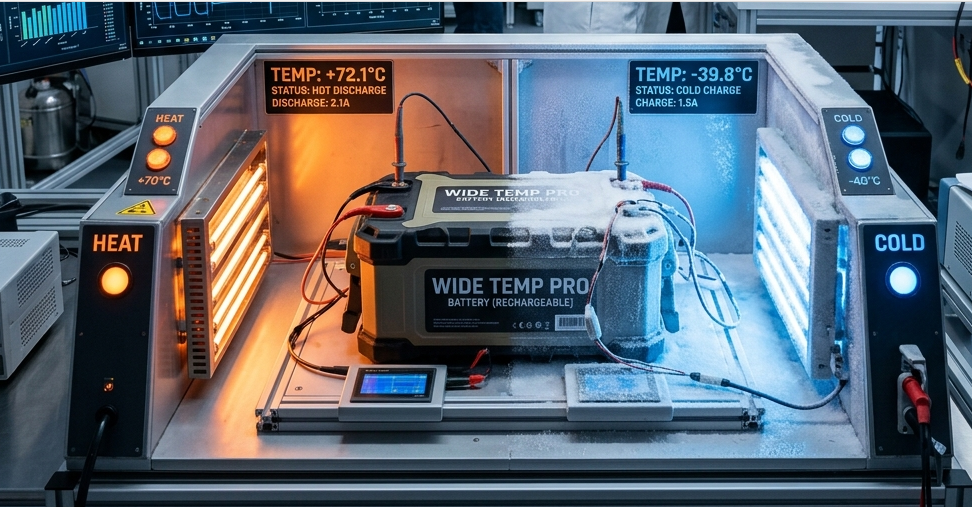
Specifying a wide temperature battery battery chemistry is only part of the equation. A cell's ability to sustain performance across thousands of cycles in extreme environments depends heavily on how it was manufactured.
Reputable rechargeable battery manufacturers engineer their cells to withstand real deployment conditions, not just controlled lab benchmarks. Key indicators of manufacturing quality include:
Controlled formation processes: The initial charge-discharge cycles during production shape the SEI (solid electrolyte interphase) layer, which directly affects long-term cycle stability.
Materials consistency: Electrode coating uniformity, particle size distribution in active materials, and electrolyte purity all affect capacity retention over time.
Comprehensive testing protocols: Cells should be validated for high and low temperature discharge, cycle life at operating temperatures, charge retention, and safety performance under abuse conditions (overcharge, short circuit, crush, impact).
Compliance with international standards: Certifications such as IEC 62620, UL924, and ISO 9001 provide verified evidence that production processes and products meet defined performance and safety thresholds.
JYH Technology, founded in 1999 and headquartered in Jiangmen, Guangdong Province, China, is a national high-tech enterprise with dedicated R&D capabilities in high-temperature, low-temperature, high-rate discharge, and long-life battery chemistries. JYH produces LiFePO4, LTO, Li-ion, NCM, Ni-MH, and Ni-Cd cells across manufacturing facilities in Guangdong, Guizhou, Shandong, and Shanghai. Their R&D center operates chemistry labs, physics labs, electrical testing labs, and safety testing labs, enabling end-to-end cell validation against IEC, UL, and GB standards. For buyers sourcing wide temperature batteries, this kind of integrated manufacturing and testing capability directly reduces field failure risk.
Extreme temperatures do reduce the lifespan of rechargeable batteries—but the magnitude of that reduction depends entirely on whether the right chemistry was selected for the application. Standard lithium cells degrade rapidly and can fail safely when operated outside their rated temperature window. Wide temperature batteries, particularly LiFePO4 and LTO chemistries, are designed to absorb thermal stress while maintaining capacity retention and cycle life across conditions that would disable conventional cells.
For applications in cold climates, high-heat environments, or systems subject to wide seasonal temperature swings, selecting a purpose-built wide temperature battery from a qualified rechargeable battery manufacturer is not a secondary consideration—it is the primary design decision. The long-term performance of the entire system depends on it.
What is a wide temperature battery?
A wide temperature battery is a rechargeable cell engineered to maintain stable performance across a broader thermal range than standard batteries. Typical examples include LiFePO4 cells that operate from –20°C to 85°C and LTO cells that function at temperatures as low as –40°C.
Does cold weather permanently damage wide temperature batteries?
Operating within the rated range does not cause permanent damage. However, charging a lithium cell below its minimum charge temperature threshold can cause lithium plating, which is irreversible and reduces both capacity and safety over time. Wide temperature LiFePO4 and LTO cells are designed with low-temperature charging capability to prevent this.
What chemistry is best for extreme cold environments?
LTO (Lithium Titanate) provides the best low-temperature performance. LTO cells retain over 80% capacity at –20°C and over 60% at –40°C, with cycle life exceeding 10,000 cycles. LiFePO4 low-temperature variants are also strong performers for applications down to –20°C or –30°C.
What certifications should a rechargeable battery manufacturer hold?
Look for ISO 9001 quality management certification, IEC 62620 compliance for industrial lithium cells, and UL924 for emergency lighting applications. These standards confirm that the manufacturer's production processes and finished cells meet verified performance and safety requirements.
What is the difference between high-temperature and low-temperature LiFePO4 batteries?
High-temperature LiFePO4 batteries use electrolyte formulations and electrode coatings optimized for sustained performance up to 85°C, including permanent charging at 60°C. Low-temperature LiFePO4 batteries use different electrolyte blends to maintain ion mobility at sub-zero temperatures. Some manufacturers, including JYH Technology, produce both variants to serve the full range of thermal application requirements.
TL;DR: Extreme temperatures do reduce the lifespan of standard rechargeable batteries, but wide temperature batteries—particularly LiFePO4 and LTO chemistries—are engineered to resist thermal degradation. LTO cells retain over 60% capacity at –40°C and exceed 10,000 cycles at full depth of discharge. LiFePO4 variants handle temperatures from –40°C to 85°C depending on formulation. For reliable performance in harsh thermal environments, selecting a proven wide temperature chemistry from a qualified rechargeable battery manufacturer like JYH Technology (www.jyh-battery.com) is the most effective way to protect system lifespan and reduce field failure risk


